
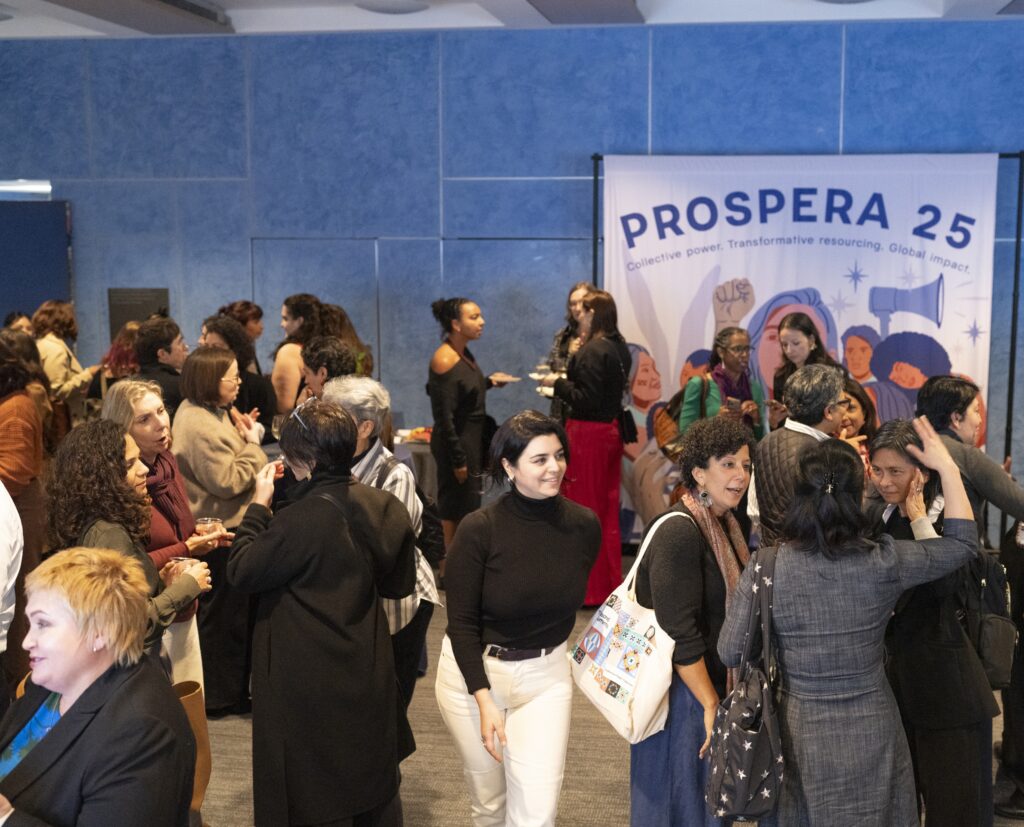
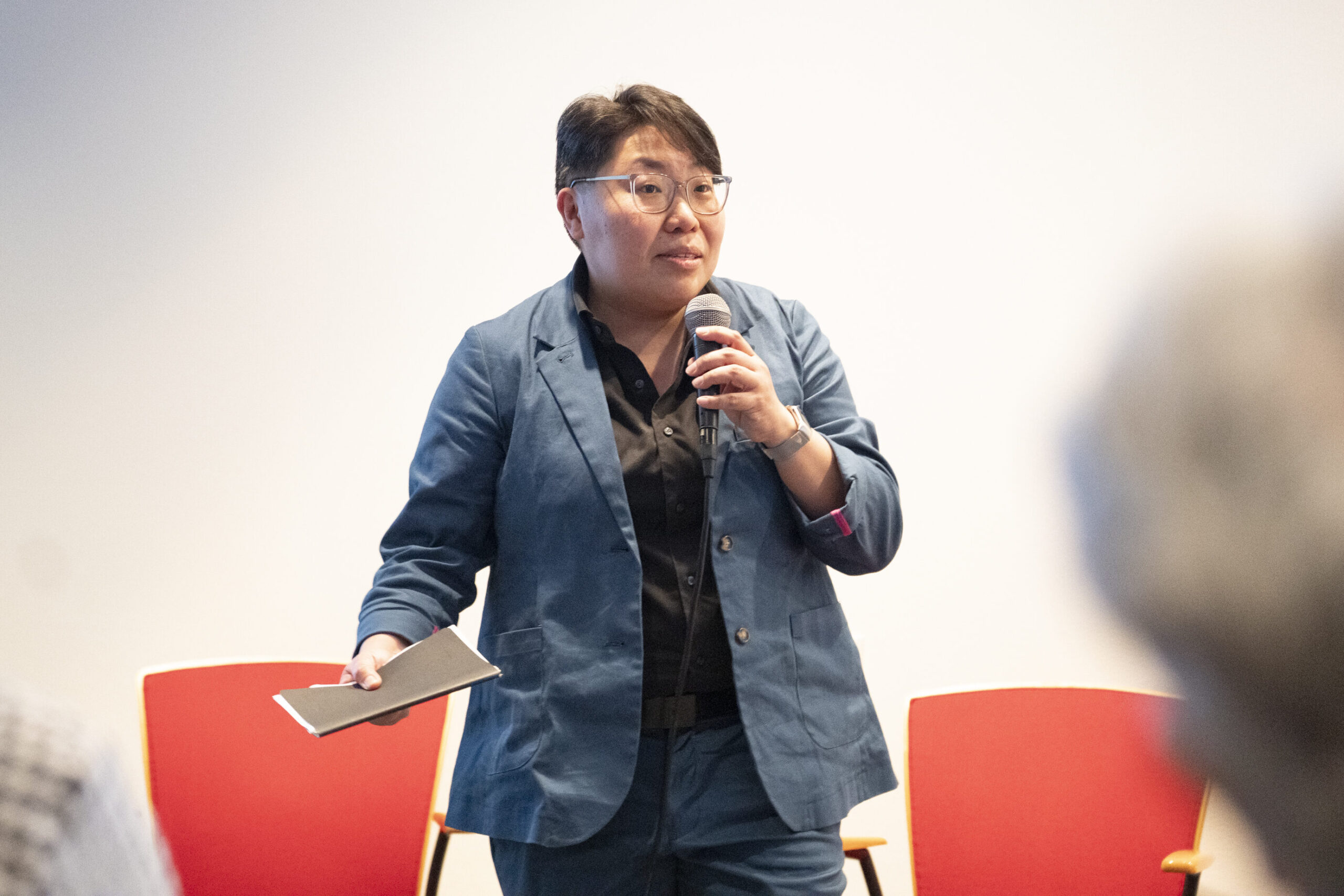
“We are celebrating 25 years of community, of collective action, of co-creation.” With these powerful words, Prospera Board Member and Executive Director of the Astraea Lesbian Foundation for Justice Joy Chia opened our anniversary reception in New York, on the sidelines of CSW70.
Set against the especially fraught and difficult political moment surrounding this year’s CSW, the reception was designed as more than a celebration. It was an intentional space to reflect on the feminist funding ecosystem that Prospera’s members and allies have built together over the past quarter century — and to reaffirm why that infrastructure matters even more now, in a context shaped by backlash, crisis, and deepening inequality.
More than 100 activists, Prospera members, partners, donors, and longtime movement allies joined the reception. Together, they gathered not only to celebrate Prospera’s anniversary, but also to reflect on what it means to resource feminist movements in ways that shift power, sustain resistance, and build toward justice.
The evening featured remarks from partners and allies across philanthropy, government, and feminist movements, including the Foundation for Just Society, the Australian government, and Prospera leadership.
What 25 Years of Collective Power Have Made Possible
“The original funds that came together to build what later became Prospera understood something very fundamental,” Interim Co-CEO of the Foundation for Just Society Maitri Morarji reflected,” which is that the power of the global feminist movement is infinitely stronger when we work together.”
Drawing on her long relationship with the network, Maitri situated the anniversary in a longer political arc. The issues facing women’s rights movements in the early 2000s, she said, “are quite similar to what we’re experiencing now: progress led by activists to advance rights, but also fragmentation in the funding ecosystem, and growing pushback against civil society. Yet, as she pointed out, “it’s probably worse now than it was back then.”
Against that backdrop, Prospera’s evolution takes on even sharper significance. What began, in Maitri’s words, as “an ambitious idea to fill emerging needs” and “a visionary move” by women’s and feminist funds to “step up out of isolation” has become both “the central nervous system of global feminist philanthropy” and “the heartbeat of the gender justice movement.”
That point became even clearer as Maitri returned to the skepticism that surrounded networks in the early years, and how Prospera has become a testament to what networks can make possible: raising the visibility for women’s and feminist funds, especially national funds that might otherwise never have gained global recognition, and leveraging a collective voice strong enough to shape major conversations. “Now there are no big important conversations that happen without Prospera and women’s funds at the table,” she said, “which is not how it used to be.”
The discussion further highlighted one of Prospera’s core strengths: making transnational feminist exchange possible. Speakers noted that Prospera matters not only because it connects funds, but because it helps feminist movements share tactics and experiences that have already been tested “left, right, backwards and forwards.”
The anniversary also surfaced a truth long embedded in Prospera’s history: this has always been a collective project. Prospera’s former Executive Director Emilienne de Leon returned the conversation to one of the evening’s central truths: “Prospera is a collective vision that we build together.” Reflecting on years of building and rebuilding the network, she spoke of her pride in seeing how Prospera has continued to grow and develop; a reminder that its strength lies not in individual ownership, but in shared labor over time.
Shifting Power Through Resourcing
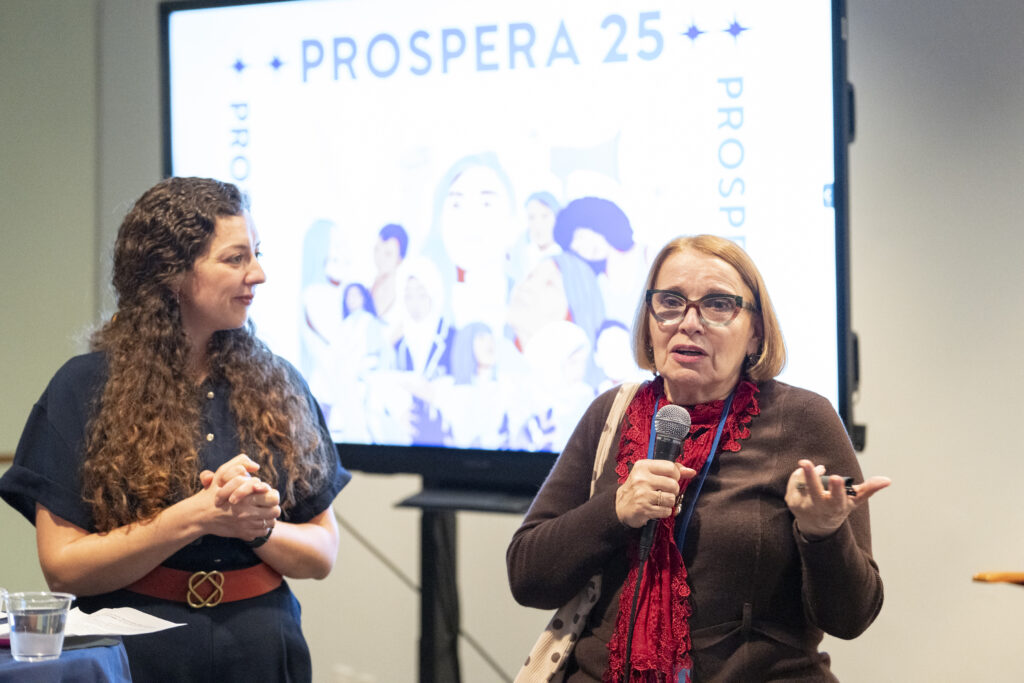
One of the clearest themes to emerge from the evening was that resource allocation is never neutral. Joy Chia named this directly: “There’s such power inherent in the decisions about how we allocate resources. Resources of time, resources of energy, resources of money, of course… Who decides where the funding flows, what it looks like, and what support looks like.” This framing was an important reminder that feminist funding is not only about how much money moves, but about who gets to decide, whose priorities shape that movement, and whether funding reproduces hierarchy or shifts power closer to communities.
That is what makes the women’s and feminist funds’ approach so significant. “When we give flexible long-term grants, we are also saying, you get to decide,” Joy said. “You decide how you want to spend your money, how you want to invest your resources, you decide what your priorities are.”
Since 2011, Prospera’s 49 member funds have moved more than US$830 million and more than 60,000 individual grants directly into the hands of grassroots groups. The deeper point, though, was not only scale. It was trust. It was the political meaning of resourcing in ways that allow movements to define their own priorities.
The evening also looked beyond how funding moves to the question of what it would take to resource feminist movements at the scale they need. The Accelerate Together campaign was cited as a “tremendously ambitious” effort by Prospera, Mama Cash, Gender Funders Collab, and the Alliance for Feminist Movements to mobilize US$600 million a year for three years for feminist movements. Joy insisted these numbers were “just the bare minimum” of what movements should be able to count on, adding that scale must be built collectively: “Accelerate Together, doing it with friends.”
Why Women’s and Feminist Funds Matter More Than Ever
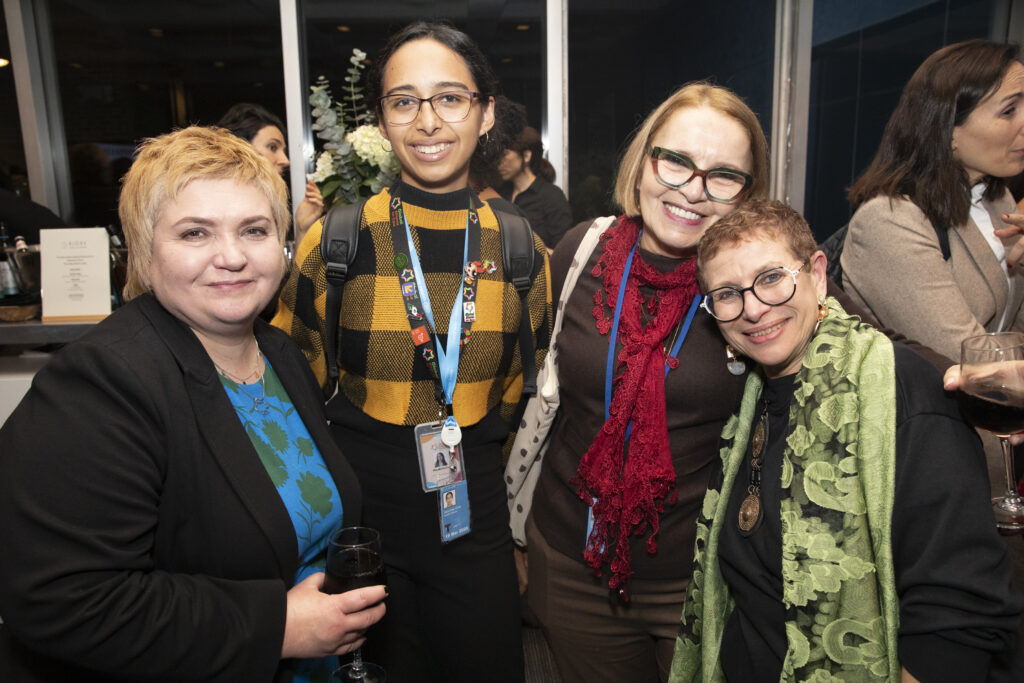
If earlier reflections in the evening clarified what distinguishes women’s and feminist funds and their collective power, Adeline Azrack, Managing Director of Fondation CHANEL Americas, and Michelle O’Byrne, Australia’s Ambassador for Gender Equality, discussed why that model matters so much in practice.
The discussion spoke directly to a central question: Why invest in women’s and feminist funds? Drawing on Octavia Butler’s words, “All successful life is adaptable, opportunistic, tenacious, interconnected, and fecund,” the conversation highlighted the qualities that make women’s and feminist funds so effective under pressure: They are pivoting, shapeshifting, remaining adaptable and building resilience.
Speakers reflected on how large institutions can sometimes stall at precisely the moment speed matters most, with bureaucratic approvals standing in the way of urgent support. Meanwhile, women’s and feminist funds remain flexible, rooted, and responsive in moments of crisis.
O’Byrne reinforced that argument from a government perspective. Supporting gender equality, she stressed, is not “a nice to have,” but “an essential to have,” and a core Australian value tied to both national security and economic prosperity. At the same time, she acknowledged the limits of state systems. Governments, she said, come with “a whole lot of structures” and “a whole lot of reporting,” and in this political moment, they are under growing pressure from constituencies shaped by anti-rights backlash not to fund beyond their own borders. The challenge is to remain true to those values while recognizing that governments are “not necessarily the deliverer that can get us close to the ground.”
Australia’s AIR program was highlighted as well, described as “fundamentally about getting out of the way.” Through that approach, Australia has supported 495 grants to women’s rights organizations and human rights actors across 25 countries in the Indo-Pacific, working through partners including the Pacific Feminist Fund, Women’s Fund Asia, Urgent Action Fund, and Women’s Fund Fiji. O’Byrne also pointed to a new phase of that work: “We’re remodelling from the things that we’ve learnt,” she said, “to make sure we’re funding it to where it needs.”
A Network That Holds Complexity
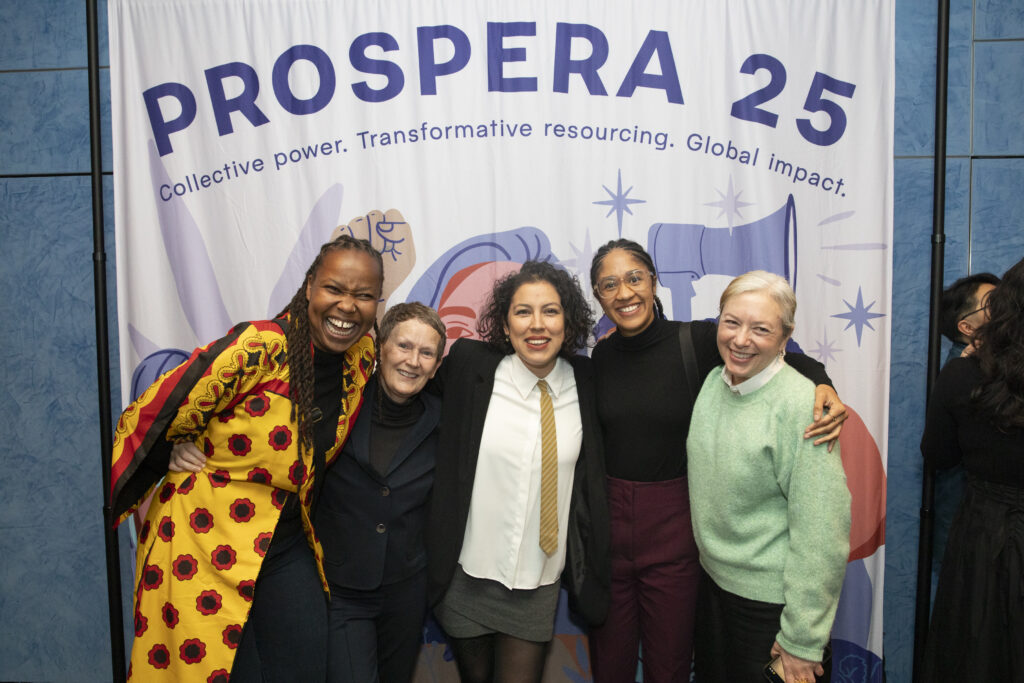
Another powerful thread running through the evening was Prospera’s refusal of rigid categories, pointing that one of the network’s strengths is the diversity of its members.
In a world where anti-gender movements are trying to divide communities and force them into boxes, Joy reflected on the importance of a network that has held space for complexity. The fact that the Astraea Foundation has been part of Prospera’s story from the beginning, and remains part of the network today, was one reminder of that continuity. So too was Prospera’s ability to hold a “vibrant and diverse” community in which women’s funds, LGBTQI funds, and other feminist funds all belong, and all are valued.
Reflecting & Building the Next Chapter Together
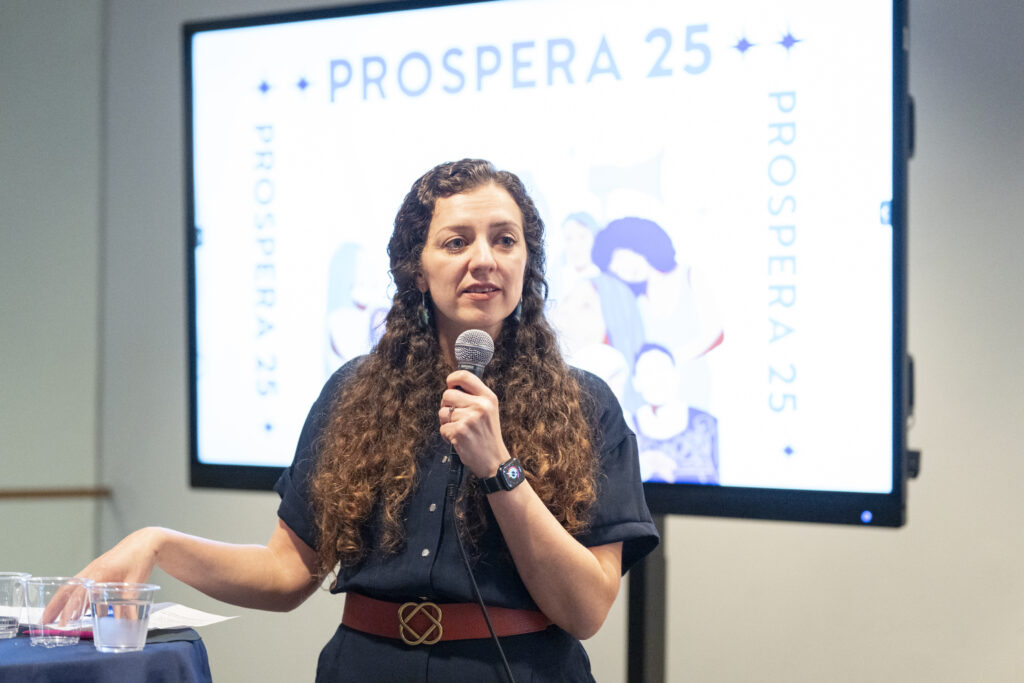
As the evening drew to a close, Prospera Executive Director Laila Alodaat invited the room to look back on the network’s beginnings. Twenty-five years ago, six funds from very different realities came together around a shared belief: that we all deserve to live with dignity, that human rights must be upheld, and that movements need a strong community behind them. Those six funds, she reminded the audience, are now 49.
That growth, however, is not only a matter of numbers. Since 2011, the network’s funds have put nearly US$900 million into the hands of movements but, as Laila stressed, “it’s not only the amount, it’s how it’s given”. Three-quarters of the funds in the network are based in the Global South and East, keeping decisions closer to communities. Nine out of ten provide core, unrestricted funding. And almost all do far more than grantmaking alone. “Prospera is not only the sum of its funds,” she said. “Together, our members managed to achieve what each fund wouldn’t have been able to do alone”: build initiatives, create financial instruments, democratize information, and move with movements into the demands of the present.
As we closed the evening, Laila shared some final reflections: “Wherever there’s injustice, there’s going to be resistance. And wherever there’s resistance, there’s going to be a movement to resource it and support it to win. And that is you. That is our funds”.
That may be the clearest way to understand Prospera’s anniversary: not simply as a reflection on 25 years past, but as a reminder of what women’s and feminist funds have made possible and of what movements will continue to need in the years ahead: collective power, grounded infrastructure, and resourcing that trusts feminist movements not only to survive, but to lead.