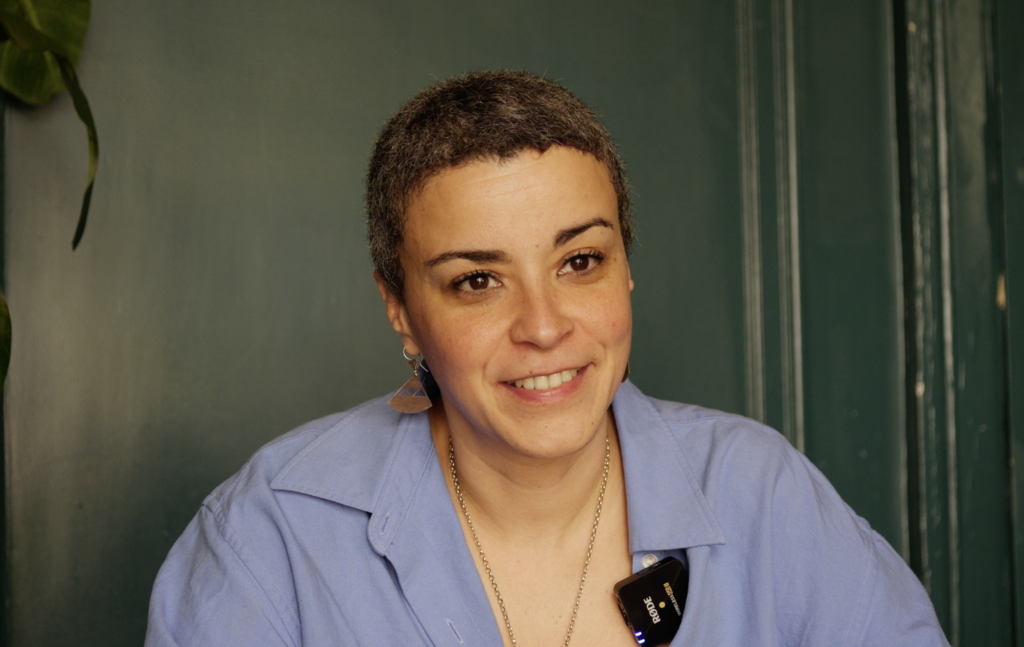
When Amina Izarouken first encountered the Mediterranean Women’s Fund in 2013, she was one of the young feminists participating in its inaugural leadership program in Algeria. More than a decade later, she leads the very organization that helped shape her journey.
In this interview, Amina shares why women’s and feminist funds are more than grantmakers, how accompaniment transforms movements, and why she believes the future is feminist.
Q: Can you tell us about yourself, the Mediterranean Women’s Fund, and the work you do across the region?
I am Amina. I am an Algerian feminist, and I have been the Co-Director of the Mediterranean Women’s Fund for the past two years.I lived in Algeria before joining the team, and I am now based in Paris.
The Mediterranean Women’s Fund is a feminist fund that works across the 21 countries of the Mediterranean. We work across both the North and the South of the Mediterranean, trying to connect the two and make borders matter less, because today it is important to have a vision that challenges borders.
We strengthen the women’s movement across the region, connect feminists with one another, train new generations of feminist leaders, and advocate with institutional donors for more funding for women; funding that is flexible and accessible.
Q: Your own journey with the Mediterranean Women’s Fund spans more than a decade. Looking back, what are you most proud of?
I joined the Mediterranean Women’s Fund as Co-Director two years ago, but I first encountered the Fund in 2013, when it launched a feminist leadership programme based on collective intelligence. I was part of the first generation of young feminists trained by the fund in Algeria.
Since then, I have grown up with the culture of the Mediterranean Women’s Fund. I have never stopped following the fund or being accompanied by it.
I created my own organization —the Feminist Collective of Algiers— which was also supported by the fund. Later, I became the fund’s advisor for Algeria, and eventually I joined its team.
This journey is not only mine. It is the story of many women across the different countries where the Mediterranean Women’s Fund works.
It is our story of growing within a feminist culture rooted in care and sisterhood.
That is what makes me proud: that this relationship became stronger over time. It did not end with the first training; it continued to grow.
Q: How would you describe a feminist fund, and what makes feminist funding different?
For me, a feminist fund is first and foremost a militant fund.
We come from the women’s movement ourselves. We are activists. That is what makes us fundamentally different from other donors.
We are not simply funders or intermediaries. We are part of the women’s movement.
We are on the ground.
Coming from the women’s movement and being activists makes all the difference.
How does the Mediterranean Women’s Fund put those principles into practice?
The Mediterranean Women’s Fund was founded by feminists from across the Mediterranean—from both the North and the South.
That is important because they came from the feminist movement and knew the realities on the ground.
Our team is very diverse. We have Algerian, Egyptian, Lebanese colleagues, and our Board is equally diverse. Through both our team and our governance, we try to reflect the diversity of the Mediterranean region.
For me, this knowledge of the field is essential.
We also have advisors across the Mediterranean —people and organizations who accompany our work and are based in the communities we support.
Being present on the ground through our team, our Board, and our advisors keeps us close to the real needs of the organizations we accompany.
Feminist funds often say they do more than provide grants. What does that look like in practice?
Even when we provide financial support, our partners often tell us that what we offer goes beyond money.
It is moral support.
It is political support.
For us, it is important to accompany organizations, provide training, connect feminists with one another, create spaces where they can meet, and advocate for the women’s movement.
That is also our role.
It is not only about giving grants.
Giving grants is important —we should never deny that.
But giving grants with the commitment to accompany organizations and go further is what makes the difference.
What has being part of Prospera meant for the Mediterranean Women’s Fund?
Being part of Prospera makes us feel less alone.
Simply being together, thinking together, and becoming a force for change —that is what Prospera brings.
We each contribute to one another, and that is the richness of this network.
Q: Can you share an example of how working with Prospera members has strengthened your work?
The Mediterranean Women’s Fund had always been reluctant to work with institutional donors.
But together with Prospera, and with other member funds such as Calala and AWDF, we were able to advocate for more funding for women’s movements within the European Union.
We also applied together for a CERV project from the European Union.
We would not have done it on our own because these funding mechanisms are very demanding.
But being part of a consortium with other feminist funds gave us the confidence to move forward.
Together, we found the courage to do it.
As Prospera celebrates 25 years, what gives you hope for the future?
I am convinced that the future is feminist.
As Prospera celebrates its 25th anniversary, I continue to have hope for all of us, and I truly believe that the future will be feminist.
For me, it is important that we continue this work because the world needs us and the world needs a truly feminist and political vision.